
Welcome!
Welcome to the new CancerGRACE.org! Explore our fresh look and improved features—take a quick tour to see what’s new.




Dr. Jack West is a medical oncologist and thoracic oncology specialist who is the Founder and previously served as President & CEO, currently a member of the Board of Directors of the Global Resource for Advancing Cancer Education (GRACE)
Since the introduction of the epidermal growth factor receptor (EGFR) tyrosine kinase inhibitors (TKIs) for patients with lung cancer, we have seen a subset of patients do remarkably well, with dramatic and long lasting responses. Unfortunately, within a few months of those impressive responses, we learned that people invariably develop acquired resistance to these agents. Over the past period of more than a decade, lab-based scientists, oncologists, and of course patients have been eagerly seeking treatments that can lead to promising responses again in patients who have developed acquired resistance. A couple of new agents show promise that we haven't seen before in this setting, and they are now the subject of emerging clinical trials that show the promise of breaking an impasse that has existed for more than a decade.
The first of the two I'd like to highlight is CO1686, from Clovis. This "third generation" oral irreversible EGFR inhibitor effectively blocks not only activating mutations but the most common mechanism of resistance, the T790M mutation that is detected in about 60% of tumors that demonstrate acquired resistance after a response. It also has the potential advantage of not inhibiting "wild-type" (non-mutated) EGFR at the typical doses used, which means that it doesn't cause the same severity of rash and diarrhea that the EGFR inhibitors we've had available thus far produce.
Though CO1686 is still early in testing, Dr. Jean-Charles Soria recently said that 6 of 9 patients with a T790M mutation-positive cancer demonstrated a significant response at the newly established phase II dose of 900 mg by mouth twice daily, and with no rash. Though still obviously still in early stages of development, the early promise of two-thirds of the patients in the target group responding is leading to multiple new trials, including
Clearly, this reflects a major investment and a lot of optimism in this agent.
A second agent that has shown similar promise is AZD9291, another third generation EGFR inhibitor with essentially the same mechanism of action. Dr. Malcolm Ranson and colleagues reported on results from an 89 patient trial of patients with an activating EGFR mutation and acquired resistance, though this study allowed patients with either a T790M mutation or not. The study included testing of the drug at a wide range of doses, from 20-240 mg/day, with no dose reductions required, and almost exclusively mild (grade 1 of 4) rash and diarrhea seen. What was especially encouraging was that 15 of 35 evaluable patients had a response, including 9 of 18 with a T790M mutation. The follow-up plans for this agent are still being defined, but there is a lot of excitement about this agent as well.
Though we're talking only about a few dozen patients and still learning about these agents, I've never been as optimistic about breaking through the impasse of acquired resistance in EGFR mutation-positive patients. I hope to share more information about these agents and perhaps others very soon.
Please feel free to offer comments and raise questions in our
discussion forums.

Dr. Singhi's reprise on appropriate treatment, "Right patient, right time, right team".
While Dr. Ryckman described radiation oncology as "the perfect blend of nerd skills and empathy".
I hope any...
My understanding of ADCs is very basic. I plan to study Dr. Rous’ discussion to broaden that understanding.
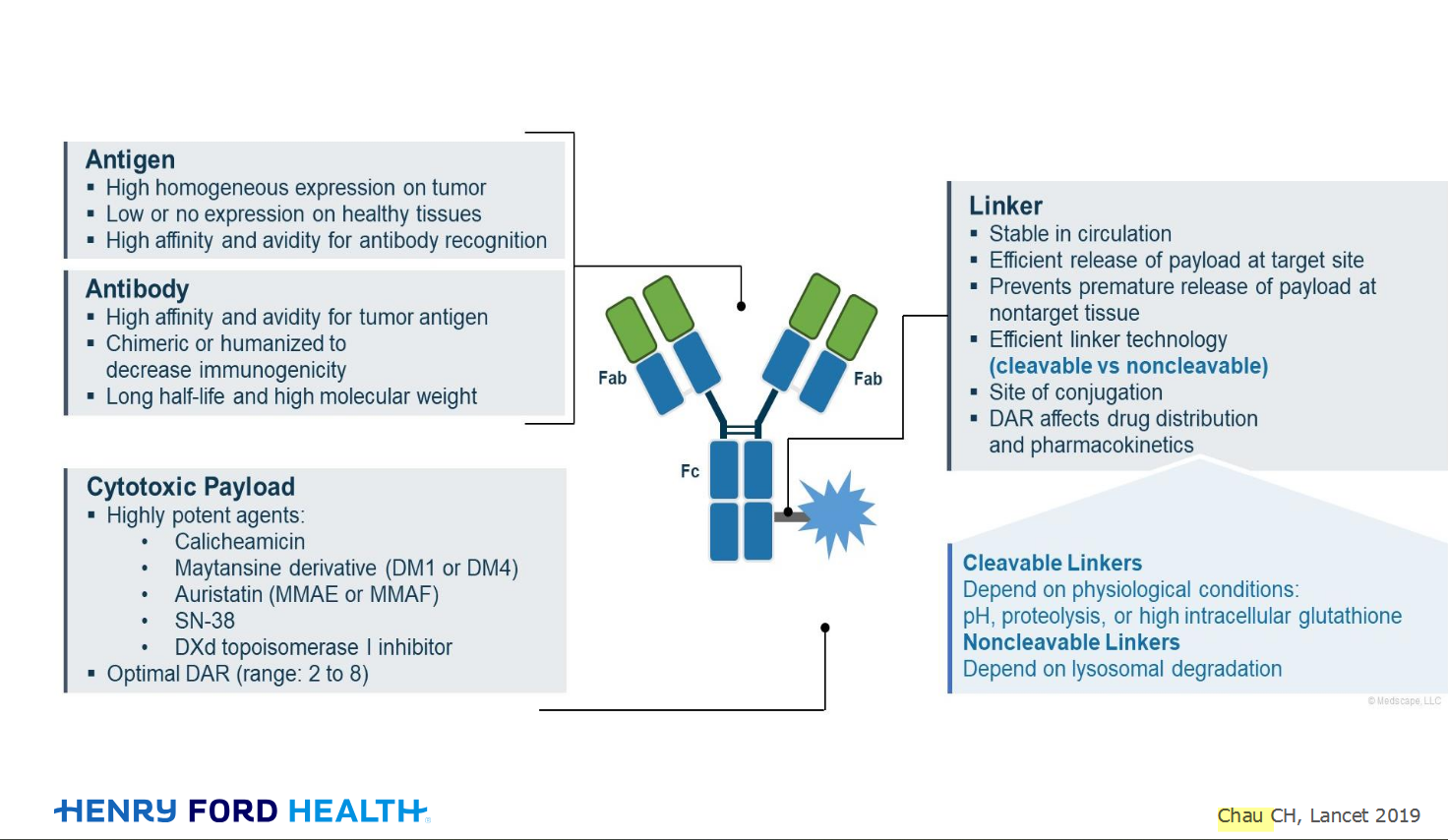
An antibody–drug conjugate (ADC) works a bit like a Trojan horse. It has three main components:
Bispecifics, or bispecific antibodies, are advanced immunotherapy drugs engineered to have two binding sites, allowing them to latch onto two different targets simultaneously, like a cancer cell and a T-cell, effectively...
The prefix “oligo–” means few. Oligometastatic (at diagnosis) Oligoprogression (during treatment)
There will be a discussion, “Studies in Oligometastatic NSCLC: Current Data and Definitions,” which will focus on what we...
Radiation therapy is primarily a localized treatment, meaning it precisely targets a specific tumor or area of the body, unlike systemic treatments (like chemotherapy) that affect the whole body.
The...

Welcome to the new CancerGRACE.org! Explore our fresh look and improved features—take a quick tour to see what’s new.
A Brief Tornado. I love the analogy Dr. Antonoff gave us to describe her presentation. I felt it earlier too and am looking forward to going back for deeper dive.