Welcome!
Welcome to the new CancerGRACE.org! Explore our fresh look and improved features—take a quick tour to see what’s new.



Displaying Results 106 - 120 of 125
Dr. Ross Camidge, University of Colorado, discusses management of CNS progression for ALK-positive NSCLC including monitoring frequency and preferences between systemic and radiation therapy.
Dr. Ross Camidge, University of Colorado, explains the preference for crizotinib rather than platinum doublet chemotherapy as first line treatment for patients with ALK or ROS1 rearrangements.
Dr. David Harpole, Duke University Medical Center, describes how he assists patients with the surgical decision-making process.
Dr. Nasser Hanna, Indiana University Health, discusses the possible role of immunotherapy in locally advanced NSCLC.

Dr. Nasser Hanna, Indiana University Health, reviews efforts to utilize targeted therapies as consolidation after chemoradiation in locally advanced NSCLC.
Dr. Jared Weiss, UNC Lineberger Comprehensive Cancer Center, describes the types of situations in which local therapy is appropriate for treating limited acquired resistance.
Dr. Jared Weiss, UNC Lineberger Comprehensive Cancer Center, discusses the use of single agent vs. doublet chemotherapy in elderly patients.
Dr. Nathan Pennell, Cleveland Clinic, describes treatment of NSCLC patients with HER2 mutations using agents such as Gilotrif or Herceptin.
Dr. Nathan Pennell, Cleveland Clinic, discusses acquired resistance to Xalkori in ALK-positive patients, and second generation inhibitors designed to overcome that resistance, such as Zykadia and alectinib.
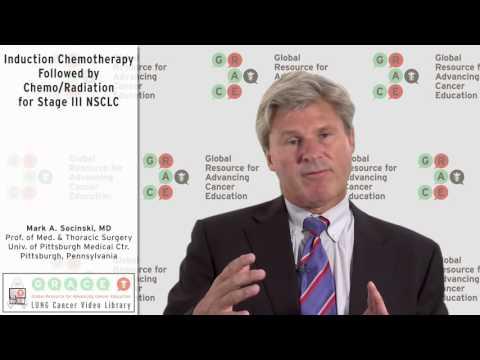
Dr. Mark Socinski, University of Pittsburgh Medical Center, discusses the benefits of giving two additional cycles of chemotherapy in combination with radiotherapy for stage III NSCLC.
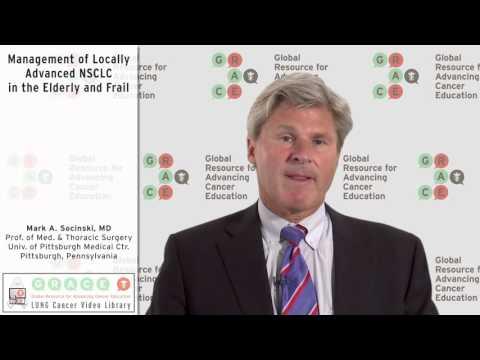
Dr. Mark Socinski, University of Pittsburgh Medical Center, describes strategies for treatment of the elderly and frail patient with locally advanced NSCLC.

Dr. Mark Socinski, University of Pittsburgh Medical Center, discusses the factors to consider in defining resectability in stage IIIa lung cancer.
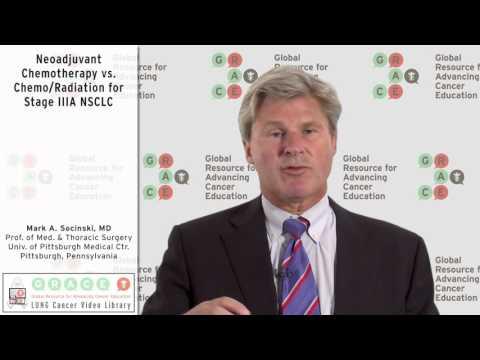
Dr. Mark Socinski, University of Pittsburgh Medical Center, compares the use of chemotherapy to chemo/radiation in the preoperative setting in stage IIIA lung cancer.
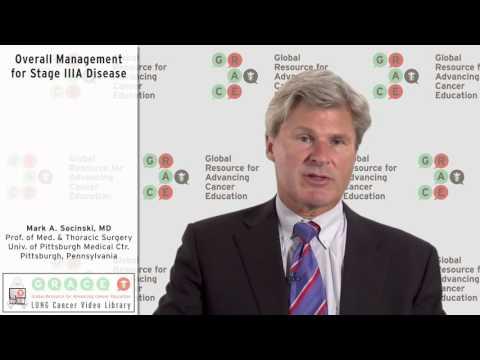
Dr. Mark Socinski, University of Pittsburgh Medical Center, describes the primary treatment options for stage IIIA NSCLC, including chemoradiation and surgery, and discusses trial evidence for each approach.

Dr. Mark Socinski, University of Pittsburgh Medical Center, defines the three compartments in stage III (locally advanced) NSCLC, each of which must be treated.

Welcome to the new CancerGRACE.org! Explore our fresh look and improved features—take a quick tour to see what’s new.