Welcome!
Welcome to the new CancerGRACE.org! Explore our fresh look and improved features—take a quick tour to see what’s new.



Displaying Results 16 - 30 of 32
Dr. Luis Raez, MD FACP FCCP, Chief of Hem/Onc and Med. Dir. at Memorial Cancer Institute, and Clinical Associate Prof. of Medicine at FL International University discusses Liquid Biopsies for EGFR.

Dr. Luis Raez, MD FACP FCCP, Chief of Hem/Onc and Med. Dir. at Memorial Cancer Institute, and Clinical Associate Prof. of Medicine at FL International University discusses treatment options for acquired resistance to EGFR TKIs: T790M-negative disease.

Dr. Luis Raez, MD FACP FCCP, Chief of Hem/Onc and Med. Dir. at Memorial Cancer Institute, and Clinical Associate Prof. of Medicine at FL International University discusses treatment options for acquired resistance to EGFR TKIs: T790M-positive disease.

Dr. Luis Raez, MD FACP FCCP, Chief of Hem/Onc and Med. Dir. at Memorial Cancer Institute, and Clinical Associate Prof. of Medicine at FL International University discusses current standards and options for first-line treatment of EGFR mutation-positive NSCLC.

Dr. Luis Raez, MD FACP FCCP, Chief of Hem/Onc and Med. Dir. at Memorial Cancer Institute, and Clinical Associate Prof. of Medicine at FL International University joined GRACE to discuss different types of EGFR mutations and their potential clinical implications.
Dr. Luis Raez, MD FACP FCCP, Chief of Hem/Onc and Med. Dir. at Memorial Cancer Institute, and Clinical Associate Prof. of Medicine at FL International University joined GRACE to discuss EGFR mutation: what is it, and which patients have it?
Dr. Ross Camidge, University of Colorado, discusses management of CNS progression for ALK-positive NSCLC including monitoring frequency and preferences between systemic and radiation therapy.

Transcript One of the important points about patients with advanced lung cancer is that 30-40% of patients will develop bone metastases. I think it’s important to recognize this is not bone cancer, this is lung cancer that’s moved to the bone, and in 30-40% of patients at some point who have

Dr. Nasser Hanna, Indiana University Health, addresses the issue of prophylactic cranial irradiation (PCI) in locally advanced NSCLC.

Dr. Jared Weiss, UNC Lineberger Comprehensive Cancer Center, describes the types of situations in which local therapy is appropriate for treating limited acquired resistance.
Dr. Jed Gorden reviews the technique of pleurodesis to manage the complication of recurrent malignant pleural effusion (MPE). Transcript So we’re talking today about pleural fluid, the fluid that builds up around the lung — fluid that causes people be short of breath, often have symptoms like cough
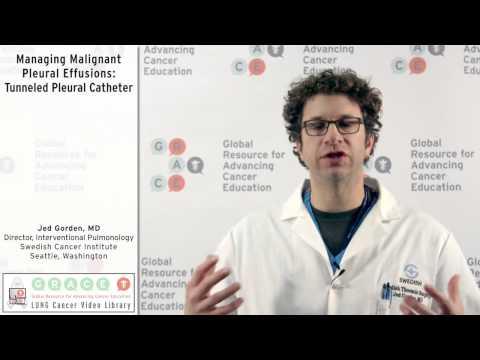
A tunneled pleural catheter is an excellent way to manage the symptoms of a recurrent malignant pleural effusion. Dr. Jed Gorden describes how it is placed and how it works. Transcript So we’re talking today about pleural fluid — fluid that resides around the lung, in-between this space that we’re

Dr. Jed Gorden describes the details of how a thoracentesis is performed in order to clarify the diagnosis and treat symptoms of a malignant pleural effusion (MPE). Transcript With the pleural fluid that’s built up around the lung — this fluid that exist in between the linings, or as we discussed

Interventional pulmonologist Dr. Jed Gorden reviews malignant pleural effusions (MPEs) are a common complication of lung cancer and some other cancers. Transcript So, I wanted to talk to you today about pleural effusions. Pleural effusions — it’s a complex term, and it’s a very common problem, so

What is the role for the neuroprotective agent memantine in patients receiving whole brain radiation therapy for brain metastases? Dr. Vivek Mehta reviews current practices to minimize risk of cognitive problems. Please feel free to offer comments and raise questions in our Discussion Forums

Welcome to the new CancerGRACE.org! Explore our fresh look and improved features—take a quick tour to see what’s new.