
Welcome!
Welcome to the new CancerGRACE.org! Explore our fresh look and improved features—take a quick tour to see what’s new.


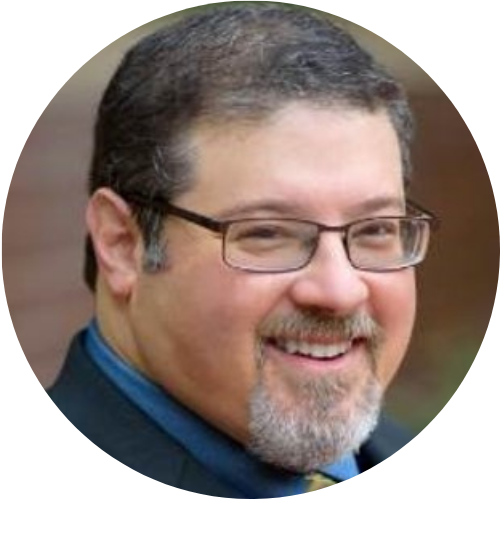
Dr. Jack West is a medical oncologist and thoracic oncology specialist who is the Founder and previously served as President & CEO, currently a member of the Board of Directors of the Global Resource for Advancing Cancer Education (GRACE)
 Every year, many of the most important developments in cancer care are presented at ASCO. This year, we've got what I think is a very important year in lung cancer, with several practice-changing results/. Impressively, this is a year in which the most important trials include some focusing on first line treatment of patients with an EGFR mutation, some on acquired resistance in EGFR mutation-positive patients, some work on MET as a target, a couple on patients with squamous NSCLC or general NSCLC that includes squamous and non-squamous NSCLC, one striking finding in stage III resected NSCLC, and even a couple of most immediately practice-changing results in small cell lung cancer.
I'll clarify that, working within the limit of a top 10 list , I couldn't include some notable but negative trials, particularly those for which we've already learned of their negativity in press releases. And while immunotherapies continue to demonstrate their promise, the presentations at ASCO this year really just reinforce what we've already seen. Because they don't break significant new ground, this isn't a year when immunotherapy trials are in the top 10 -- though I expect at leasat one or two among next year's top 10 list.
I welcome people to check out my preview of top 10 key presentations, but also to participate in a discussion about the upcoming ASCO meeting at this week's #LCSM tweet chat, which will Thursday, May 22, at 8 PM Easter, 5 PM Pacific for an hour (just add the #LCSM hashtag to your tweets and search for them, or go to http://www.tchat.io/rooms/lcsm to follow (and hopefully participate in) the conversation). In that time, people can ask questions and add comments about the ones listed, as well as raise others for consideration as attention-worthy presentations you may have heard or read about. You can find the entire collection of ASCO abstracts here.
I hope you find the top 10 list provocative and interesting. As always, I welcome your questions and comments here, as well as during the upcoming #LCSM chat.
Please feel free to offer comments and raise questions in our
discussion forums.
Dr. Singhi's reprise on appropriate treatment, "Right patient, right time, right team".
While Dr. Ryckman described radiation oncology as "the perfect blend of nerd skills and empathy".
I hope any...
My understanding of ADCs is very basic. I plan to study Dr. Rous’ discussion to broaden that understanding.
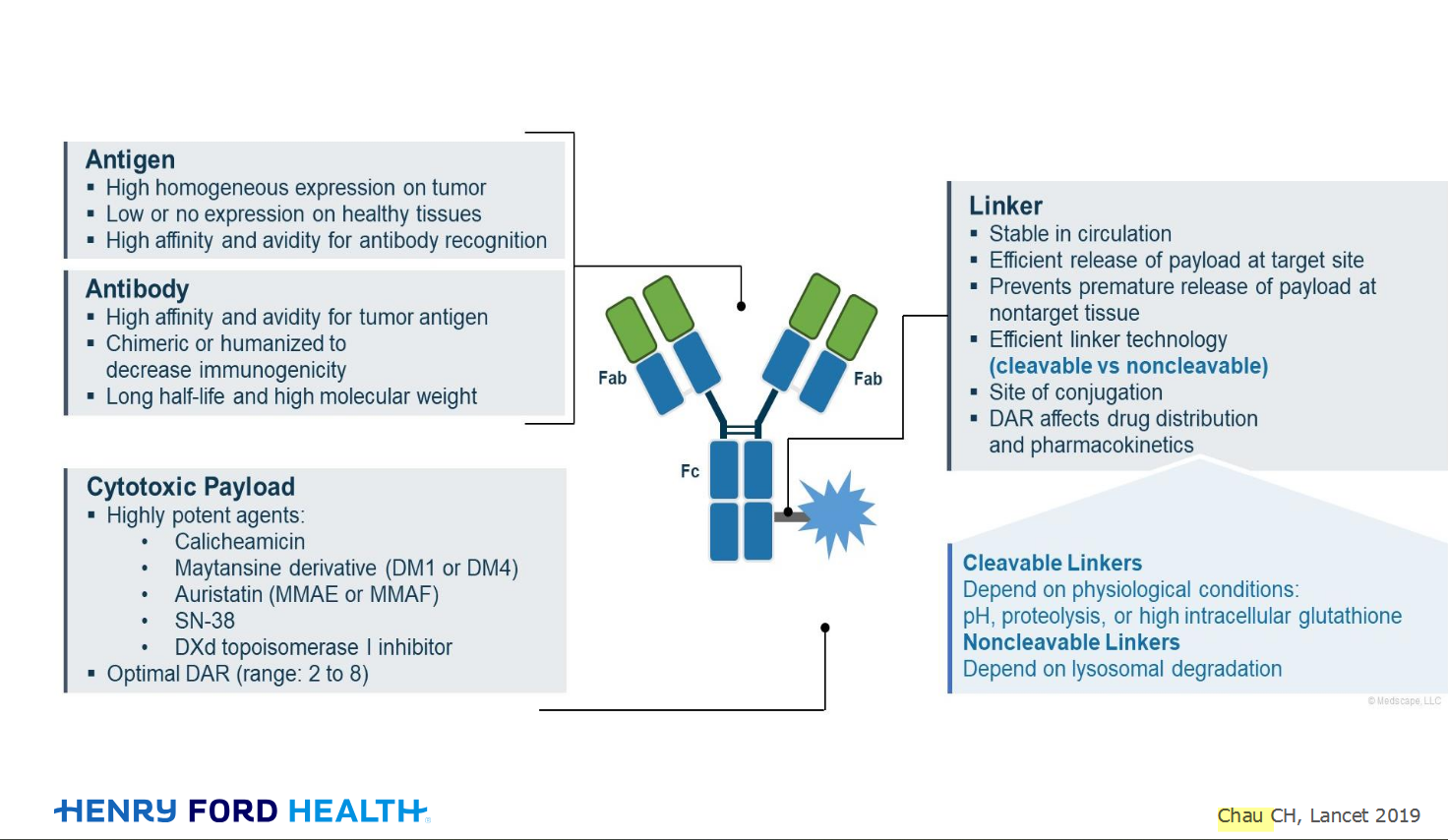
An antibody–drug conjugate (ADC) works a bit like a Trojan horse. It has three main components:
Bispecifics, or bispecific antibodies, are advanced immunotherapy drugs engineered to have two binding sites, allowing them to latch onto two different targets simultaneously, like a cancer cell and a T-cell, effectively...
The prefix “oligo–” means few. Oligometastatic (at diagnosis) Oligoprogression (during treatment)
There will be a discussion, “Studies in Oligometastatic NSCLC: Current Data and Definitions,” which will focus on what we...
Radiation therapy is primarily a localized treatment, meaning it precisely targets a specific tumor or area of the body, unlike systemic treatments (like chemotherapy) that affect the whole body.
The...

Welcome to the new CancerGRACE.org! Explore our fresh look and improved features—take a quick tour to see what’s new.
A Brief Tornado. I love the analogy Dr. Antonoff gave us to describe her presentation. I felt it earlier too and am looking forward to going back for deeper dive.